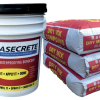

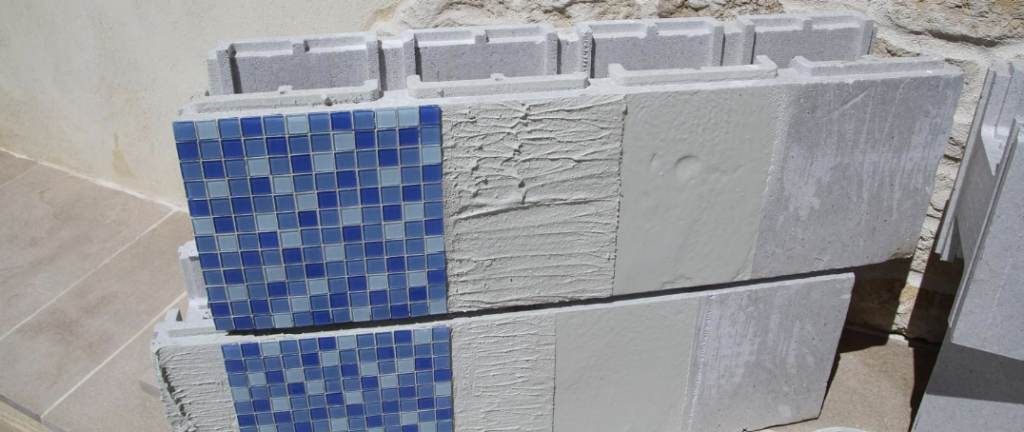

GREY GREEN KIT WHITE KIT
BaseCrete is a waterproofing and finishing coating applicable to a wide variety of substrates, including concrete blocks, tiles, cement plaster, polystyrene, metal, glass, and more. A BaseCrete kit contains two products: one 18.9-liter bucket of "milk" (a type of sealant) and three or four 22.67 kg bags of powder. BaseCrete can be applied with a roller, brush, trowel, squeegee, or spray gun. The kit, weighing approximately 90 or 110 kg, covers 19 to 22 m² at a thickness of 3 mm, which equates to approximately 5 kg per m².
1- Preparing the mixture:
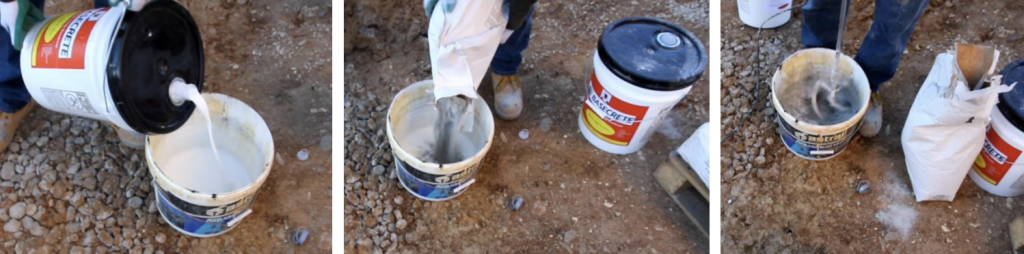
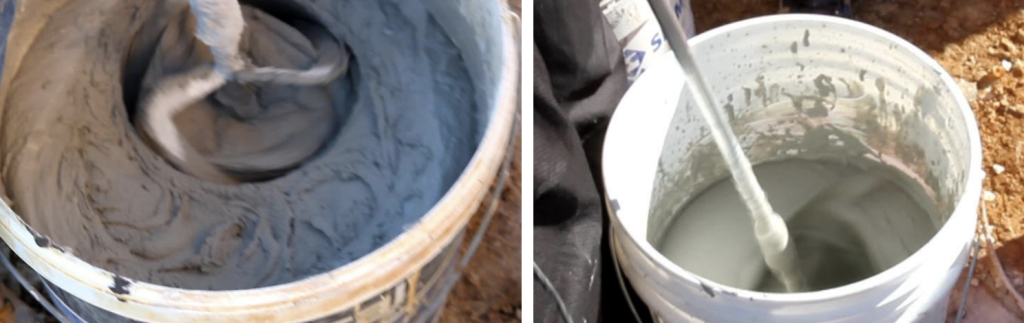
Depending on the application method, you will create a thick or liquid mixture. You will need to add more liquid or more powder to achieve the desired consistency of your mixture.
– If you wish to carry out repairs, fill gaps between the foundation slab and the walls, or apply Basecrete in a thicker layer, it is best to make a thicker mix. For application with a roller, a plastering gun, or to achieve a smooth finish, opt for a creamier mix
2- Application of the mixture: To know how to apply the mixture, it is necessary to identify the type of surface:
– On a porous surface, the mixture can be applied with a long-pile roller, a plastering gun, a brush, or a pool trowel. Dampen the porous surface before applying.
– On a smooth surface such as tiles, glass, plastic, polystyrene, it is best to apply the first coat with a plastering gun in order to cover the entire surface with a thin layer of BaseCrete.
– You can apply the following coats with a spray gun, a long-pile roller, a plastering gun, a brush, or a pool trowel.
Note, however, that using a spray gun is not mandatory. Application on smooth surfaces can be done with a roller or brush. BaseCrete should be applied by dabbing the product onto the surface. Once the BaseCrete is dry, it will adhere perfectly to the surface, and another coat can be applied.

A small point about the compressor to use for application with a plastering gun: it is imperative to use a compressor with an air exchange rate of at least 400 litres/minute.
To determine when to apply a second coat, test the hardness of BaseCrete with your nail. If the nail doesn't leave a mark on the BaseCrete, you can apply the second coat.
Application using a plastering gun:
– All coats of BaseCrete can be applied with a plastering gun. Using a Curry trowel for the final coat is not necessary if you are applying another finish over BaseCrete.
Roller application:
Use long-pile rollers to apply approximately 1.5 mm per coat. The mixture should be slightly runny. Apply the coating in a crisscross pattern to ensure complete coverage of the surface. A careful application helps to level the surface and prepare it for the next coat.
Application to the pool builder's trowel:
– Apply with a pool trowel, using a light, gentle motion to smooth it out as much as possible and avoid leaving marks. Trying to flatten BaseCrete by pressing hard will burn and mark the coating.
3- Clarifications:
– 3mm (5kg/m2) is necessary and sufficient to achieve perfect waterproofing for your pool. Provide a groove reinforced with fine-mesh fiberglass mesh. Proceed in this way also when two different materials are involved (metal with concrete, polystyrene with concrete, plastic with concrete). If your substrate moves, the reinforcement with BaseCrete coating will accommodate the ground movement.
– BaseCrete can be applied directly to concrete blocks. To avoid visible joint lines, apply a 5mm thick layer or a fast-setting smoothing or preparation compound (Sika, Lanko, Weber or T-mix) to reduce costs.
– For application on tiles, you will need more BaseCrete. A 3 mm thickness will be required on the tiles, and the joints must also be filled. If some tiles are at risk of falling, reinforce the substrate with fiberglass mesh.
BaseCrete coating is a mixture of powder and polymers. The mixture doesn't react like other coatings you might be used to applying. The mixture must be prepared according to the application temperature: the warmer it is, the less mixture you need. It's best to have at least two people on a worksite, ideally three. If the mixture hardens, never add water. Simply add the provided milk and mix again to obtain a workable consistency. In hot weather, add concrete retarder to extend the application time; above 30°C, apply at night. Professionals typically complete the application of a pool coating up to 100m² in a single day (on a thin coat, 5kg/m², flat surface, average temperature).
– When applying to polystyrene blocks, the joints must be reinforced with fiberglass mesh (4mm mesh) as well as the corners between the foundation slab and the walls. Spray the BaseCrete coating with a plastering gun as you would for tiling, then apply the other coats with a pool trowel.
– Remember to protect your patios, coping stones, fixtures, and other surfaces. While BaseCrete is still wet, you can remove splashes with a sponge and water. Once dry, it will be very difficult to remove, as will your tools, trowels, rollers, and spray gun nozzles. BaseCrete adheres to all surfaces. It is essential to clean your application equipment as soon as possible, without delay, otherwise you may not be able to remove the coating from your tools.
– Regarding smoothing with a sponge or sponge trowel (specific application):
Prepare a mixture of 50% BaseCrete milk and 50% water in a bucket. Wait for the plaster to set before smoothing it with a sponge. Be sure to adjust your application time according to the day's temperature. In the morning, BaseCrete plaster will take longer to set and become smooth than in the afternoon when it is warmer. Troweling with a sponge will raise the surface texture; wait for the plaster to set slightly, then use a white cloth to remove these grains. The surface will then be smooth.
It's still preferable to smooth the plaster with a Curry trowel, which is a flexible tool that allows you to create a smooth finish. It's also quicker and easier to do. Remember that by mixing the product as often as possible in the final coat, the finish will be easier and even more aesthetically pleasing.

The important points to remember are:
– As a finishing coat, mix the plaster very often in the bucket to aerate it; it will be easier to smooth.
How do you achieve a homogeneous mixture when adding pigments? Pour the liquid into a bucket, add the pigments, mix, then add the powder, mix again, and add more pigment if needed to obtain the correct shade. The color of the mixture in the bucket will be the same as the color in your pool once it's filled with water. This color matching process is important: be sure to weigh the different ingredients to ensure you can reproduce the mixtures identically. Once the color is confirmed, carefully note the weight of each ingredient. Then, simply weigh the different products in three separate buckets (one for the liquid, one for the powder, and one for the pigments). Mark the level reached in each bucket with a marker or orange construction tape to ensure consistent proportions. Be sure to use iron oxide-based pigments. Always mix the pigments with the liquid first, then add the powder